
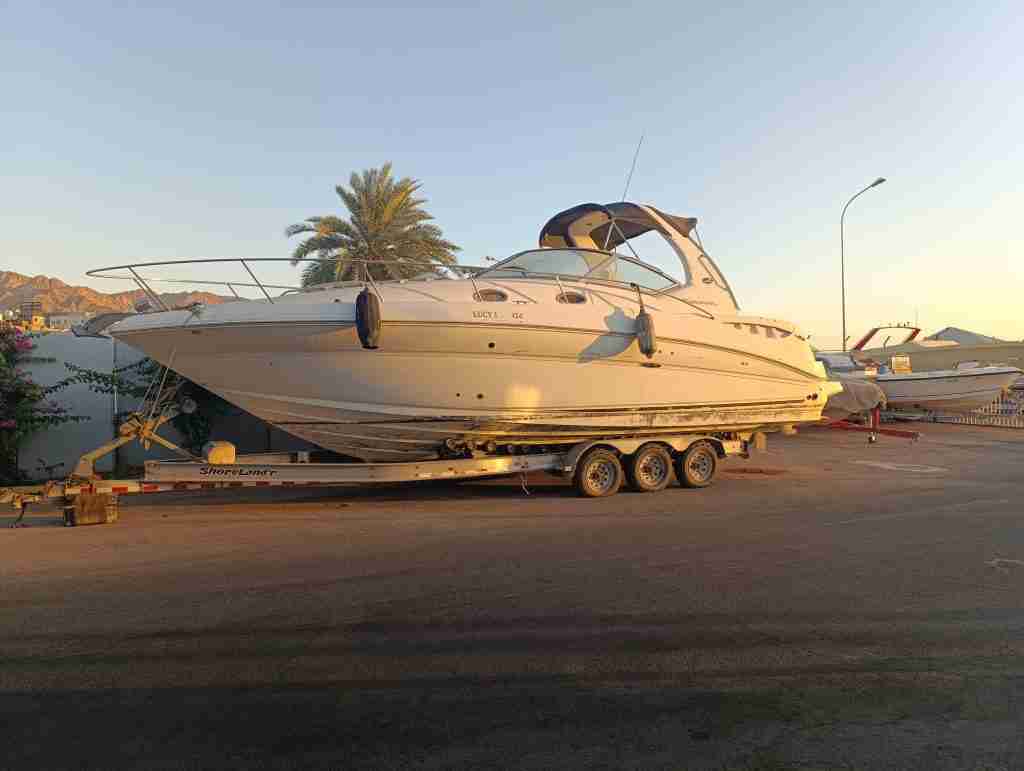
The end of the season is when a trailer is easiest to forget. The boat gets parked, the trailer rolls to the back of the yard, and nobody looks at either again until the water warms up. By then the problems that started at the ramp last summer have had all winter to get worse. This boat trailer maintenance guide covers the five areas worth checking before storage, then works through bearings, bunks, lights, and hull support.
The Pre-Storage Boat Trailer Maintenance Checklist
Most end-of-season trailer problems trace back to the same handful of components, and working through them in order takes an afternoon. The five areas are:
- Wheel bearings and hubs: Water that got past a seal sits in the hub all winter and rusts the bearing surfaces, a common cause of roadside failures.
- Bunks, rollers, and carpet: Worn carpet exposes staples that scratch the hull, and bunk boards rot from the inside out, before anything shows on the surface.
- Lights and wiring: Corroded grounds and chafed wire cause most trailer light failures, and both get worse sitting through a wet winter.
- Frame, coupler, and winch: Check the coupler, tongue jack, and safety chains, and look for rust at the welds and underside of the trailer frame. Inspect the winch strap and leaf springs for cracking and rust at the shackles.
- How the trailer sits: Weight distribution and hull support matter more over months of storage than on a short tow. Check the tires for uneven wear, though sidewall cracking usually shows up before tread wear does.
The first three are where we’d spend real time, and replacement parts sit in our boating and marine categories. This is a different list from the pre-trip check before a day on the water, since a trailer that sits fails differently than one in weekly use.
Inspecting and Repacking Wheel Bearings
Boat trailer bearings take more abuse than the ones on a utility trailer, and the ramp is why. The hubs heat up from towing, then go straight into cold water. The trapped air cools and contracts, and that drop in pressure can pull water past the seal. Freeze-and-thaw cycles make it worse, since trapped water expands.
Start with a spin test. Raise one wheel clear of the ground at the lifting point specified in your trailer’s manual, spin it by hand, and listen. Smooth and quiet is what you want. Grinding or a gritty feel indicates the bearings have been damaged. Then grip the top and bottom of the tire and rock it. Play means they’re loose, worn, or both.
Next, pull a dust cap and look at the grease. Milky, gray, or streaky means water has gotten in, and that hub needs to come apart. Pull the cotter pin and castle nut, slide the hub off, and clean out the old grease. Inspect the races and bearing rollers for pitting and for blue discoloration that signals overheating. If either shows damage, replace the bearing and race as a matched set. Complete kits in our trailer bearings and seals selection bundle the bearing, race, and seal, saving you from guessing at sizes. Then hand-pack fresh marine-grade grease and fit a new seal.
Trailer manufacturers generally call for an annual repack, but your trailer’s manual gives the schedule for your axle. Bearing protectors maintain a slight positive pressure inside the hub, which helps prevent water from entering at the ramp. They reduce the problem rather than eliminate it, so protectors don’t replace repacking.
Checking Bunks and Rollers for Wear
Bunks and rollers separate your hull from a steel frame, and they wear where it’s easy to miss. Run your hand along the carpet on each bunk. Thin spots, bare patches, or a staple you can feel through the fabric all mean it needs to be replaced.
Press a screwdriver into the boards underneath, at the ends and around the mounting bolts, since those spots hold moisture longest. If the tip sinks in, the board is rotting and will eventually fail under load. Check the bolts too, since they loosen over a season.
Rollers wear out in a few predictable ways:
- Cracked or split rubber: Age and UV exposure break rollers down, and a cracked one can gouge a hull on the next launch.
- Flat spots: A roller that’s carried weight in one position all winter may take a set. Moving the trailer a few feet every month or so changes where the weight rests and helps prevent that.
- Seized shafts: A roller that won’t turn will drag against the hull. Spin each by hand, and if any bind, free the shaft or replace the assembly. Replacement rollers, bunk carpet, and glide kits live in our boat trailer bunks category. Look at how the hull sits on the bunks while you’re there. If some rollers aren’t making contact, the ones that are carry more than their share.
Why do my trailer lights keep failing?
Almost always, it’s the ground. Trailer lighting usually grounds through the frame, and a frame that’s repeatedly dunked builds corrosion at every bolted connection. A bad ground rarely fails cleanly, which makes it hard to chase. You’ll see a running light dim when the turn signal blinks, or a brake light that quits when the markers come on. Those crossed symptoms mean current is returning through the wrong circuit.
The fix is to stop relying on the frame. Run a dedicated ground wire from each light back to the white wire at the connector, and the problem usually disappears for good. While you’re in there, check the harness where it passes through the frame, since chafed insulation shorts against steel and produces the same intermittent faults.
Bulbs are the other common failure, since a hot incandescent bulb that goes underwater can crack from the shock. Sealed LEDs have largely taken over for that reason. They run cooler and seal better, though the connections still corrode, so LEDs don’t remove the need for a clean ground. Unplug the harness before you back down the ramp, either way, since unpowered lights aren’t hot.
Before storage, clean the connector contacts, coat them with dielectric grease, and coil the harness off the ground. Trailer lighting is separate from the navigation lights and other safety gear required on board, and that gear has its own end-of-season checks. Test everything with the tow vehicle before you walk away.
Transom Savers and Supporting the Hull
A transom saver braces the lower unit of an outboard against the trailer, so road shock travels through the frame rather than the transom. It’s a towing device, meant to limit how far the motor swings and bounces at highway speed. Storage is a separate question.
For winter storage, where the motor sits matters more than what’s bracing it. Outboard manufacturers commonly recommend storing it fully down so water drains out of the lower unit, which matters most anywhere it freezes. Some also distinguish between a trailering support and a storage support, and the two aren’t interchangeable. The trailering supports in our transom savers and steering locks category are designed for towing. Your motor’s manual specifies the storage position and the device, since both vary by engine.
The hull needs attention too. The boat should rest on the bunks, not hang from the winch strap. Pull the drain plug and park with the tongue slightly higher than the stern so rain and snowmelt run out. A hull supported at only a couple of points can deform over months, so check the weight sits where the trailer was designed to carry it.
Getting Your Boat Trailer Ready for Next Season
Working through all five areas might feel like a lot the first time, especially if you’ve never had a hub apart. It gets faster every year. Jot down what you found and what you replaced, and next fall you’ll know where to start instead of checking everything blind. Make it part of putting the boat away, and it stops being a job you have to remember to do.
Frequently Asked Questions
How often should I repack trailer bearings?
Annual is the common recommendation, and your trailer’s manual gives the interval for your axle. Beyond that, the grease tells you the most. Milky, gray, or streaky means water has gotten in, and the hub needs service.
When do boat trailer bunks need to be replaced?
Replace the carpet when you can feel hardware through it or see bare spots. Replace the board when a screwdriver sinks into the wood at the ends or around the bolt holes.
Do I need a transom saver for storage?
Probably not, since they’re built for towing rather than long-term storage. Outboard manufacturers commonly recommend storing the motor fully down so the lower unit drains, particularly where it freezes. Some offer a dedicated storage support, which is a different device. Check your motor’s manual.
Should I store my boat trailer with the tires off the ground?
Getting weight off the tires can help prevent flat spotting during long storage, but use only the lifting points and support locations recommended by the trailer manufacturer. If raising the trailer isn’t practical, keep the tires properly inflated and move the trailer a few feet every month or so to change where the weight rests.
Experience Outdoor Living!
At Omni Outdoor Living, we make it our mission to help customers get the most out of their outdoor experiences. We offer quality outdoor products focused on outdoor recreation, DIY projects, entertaining friends and family, or just relaxing outside.


